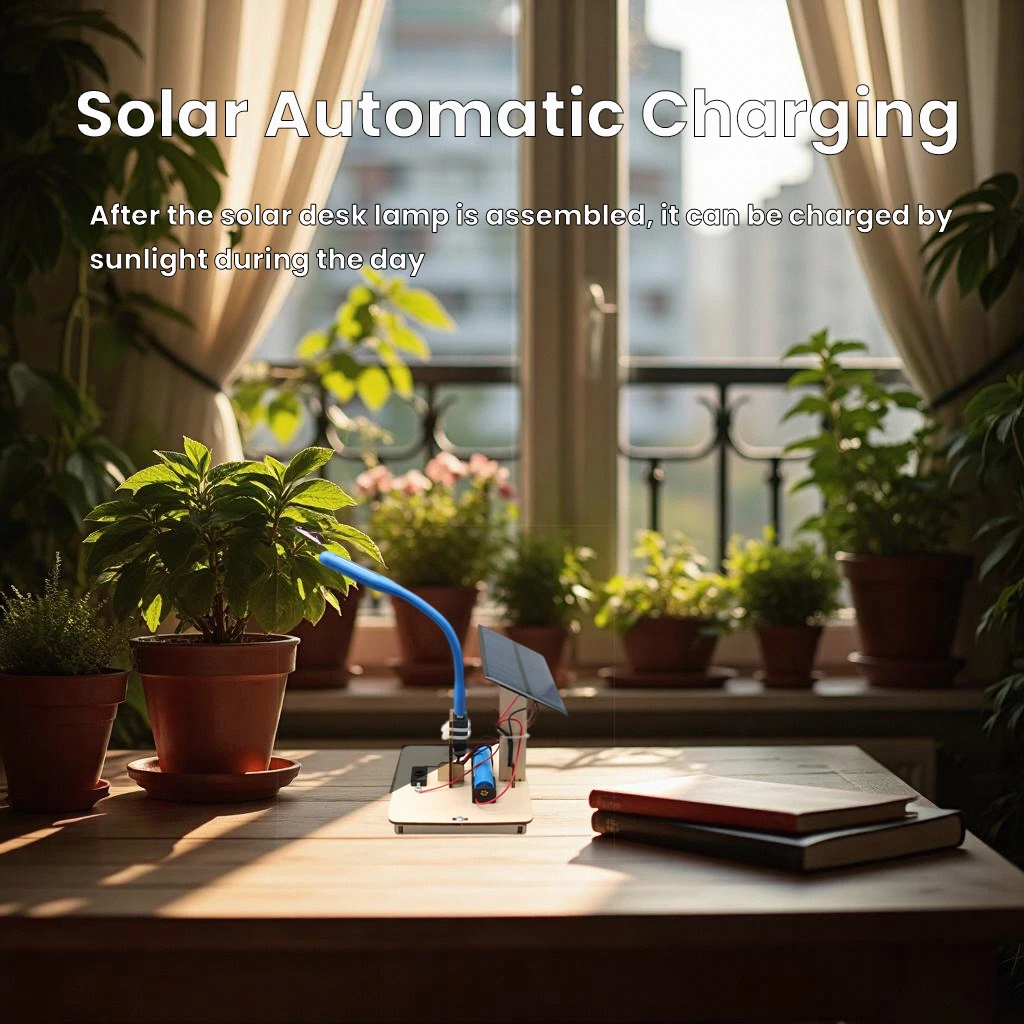
DIY solar lamp assembly is a clean energy device that can be assembled by itself through modular components. Its core design concept is to combine solar energy conversion, energy storage, and lighting functions to form a low-threshold, replicable technology practice tool. Such kits usually include solar panels (conversion efficiency of 15%-20%), rechargeable lithium batteries (capacity 1- 5Ah), LED lamp beads (brightness 20-50 lumens), and simple controllers, and the cost is controlled in the range of 5-10 US dollars.
Take the "Solar Desk Lamp Stem Educational Toy" made in China as an example. Its modular design allows children to safely complete the assembly of solar lamps, and it is easy to complete the assembly of solar lamps according to the instructions. It can be charged for 9 hours during the day through solar panels, and can provide 2-3 hours of lighting at night, with a service life of up to 5 years. What is more noteworthy is that the product comes with a teaching manual, which can guide children to understand knowledge such as the photoelectric effect and circuit basics, and transform technical tools into STEM education carriers.

The scientific and educational significance of DIY solar lamp assembly
Building an interdisciplinary knowledge network
The assembly of solar lamps involves multidisciplinary knowledge such as physics (calculation of light energy conversion efficiency), chemistry (battery charging and discharging principles), and engineering (structural stability design). For example, a practical course in a middle school in Shenzhen shows that when students adjust the angle of the solar panel to optimize the charging efficiency, they need to use trigonometric functions to calculate the optimal inclination angle and understand the impact of material thermal conductivity on battery life. This "problem-oriented" learning model transforms abstract theories into concrete operations and significantly improves the knowledge retention rate (the experimental group is 42% higher than the traditional teaching group).
Cultivate sustainable development thinking
By comparing traditional lighting methods, children can intuitively recognize the necessity of energy transformation. Rural families in Africa spend $1 per month using kerosene lamps, and the carbon monoxide concentration produced by combustion can reach 50ppm (safe value <25ppm), while solar lamps have zero emissions and reduce costs by 80%. Research at Stanford University in the United States shows that 76% of children participating in the solar lamp project will actively popularize environmental protection knowledge to their families, forming a virtuous cycle of "education-practice-communication".
Stimulate engineering innovation ability
Modular design allows personalized transformation. For example, Indian children added reflectors to solar lamps to increase brightness, and Bangladeshi fishermen converted them into night fishing signal lights. This process of "discovering problems-solving problems" is the core of engineering thinking. Data shows that children who participated in DIY projects scored 35% higher than the control group in creativity tests.
STEM education and the electricity dilemma for children in underdeveloped areas and islands
Power supply crisis
There are still 789 million people living without electricity in the world, of which 600 million are in sub-Saharan Africa. 70% of villages in Mindanao, Philippines, have no electricity, and children need to learn with the help of candles or mobile phone flashlights after sunset, with a fire risk of up to 3.7 times per village per month. Some islands in Zhuhai, China, used to rely on diesel power generation, and the electricity price in summer reached 3 yuan per kWh, which made residents afraid to use air conditioners, and the penetration rate of refrigerators was less than 10%.
STEM education resource gap
There is a gap of 4 million STEM teachers in developing countries, and the curriculum is fragmented. A survey in Pakistan showed that only 12% of schools offer interdisciplinary courses, and teachers lack integration capabilities. Due to power shortages in rural schools in Africa, multimedia equipment has become a mere decoration, and science classes have become "blackboard drawings". The World Bank report pointed out that children in such areas have only 1/20 of the opportunities to access experimental equipment in developed countries.
The intergenerational cycle of energy poverty
The lack of electricity has reduced children's average daily learning time by 2.3 hours, and the literacy rate has dropped by 17%. A study by the World Health Organization confirmed that the incidence of respiratory diseases among children in families using kerosene lamps is 3.2 times that of families using solar lighting, and the absenteeism rate has increased by 9%. This vicious cycle has caused children in underdeveloped areas to face structural disadvantages at the beginning of their lives.
The transformative impact of DIY solar lights on children's development
Educational equality: breaking resource barriers
Solar light kits provide low-cost STEM teaching aids for remote areas. After the China Rural Development Foundation donated 9,000 lamps to 20 schools in Ethiopia, students' science scores increased by 28%, and 62% of children began to record power generation data on their own. The "One Light One Letter" project in the United States allows children to exchange their experiences through letters, forming a cross-cultural learning network, and the participants' scores on interdisciplinary thinking tests have increased by 41%.
Energy independence: Unleashing economic potential
Solar lamps can save families $180 in fuel expenses each year (based on an average of 4 hours of use per day). In Kenya, the savings have increased women's handicraft income by 37% and improved children's nutrition intake by 29%. The more far-reaching impact is that a stable electricity supply makes night learning possible, and the enrollment rate of rural students in Kenya has increased by 19%.
Ability Leap: From User to Creator
The technical literacy cultivated by the DIY process has long-term value. In the "Solar Maker" program in India, 83% of the children were able to independently repair household appliances after the project ended, and 41% designed simple irrigation systems. This ability transfer makes them more competitive in the local labor market, and the average starting salary has increased by 23%.
Awakening of global citizen awareness
Children in developed countries have a deep understanding of energy justice by assembling donated lamps. A project at a school in Canada showed that the environmental donation rate of participating students increased from 12% to 67%, and 73% took the initiative to initiate campus energy conservation initiatives. This kind of empathy cultivation reserves a new generation of power to address global issues such as climate change.
Conclusion: Multidimensional Value of Illuminating the Future
DIY solar lights are not simple lighting tools, but a composite carrier that integrates technological innovation, educational empowerment and social change. Its significance is reflected in:
Individual level: through the path of "technology mastery-knowledge internalization-ability transfer", help children break through the shackles of development;
Community level: replace traditional fuels with clean energy to promote the coordinated progress of health, economy and education;
Global level: build a North-South cooperation network to cultivate a new generation of global citizens with sustainable development awareness.