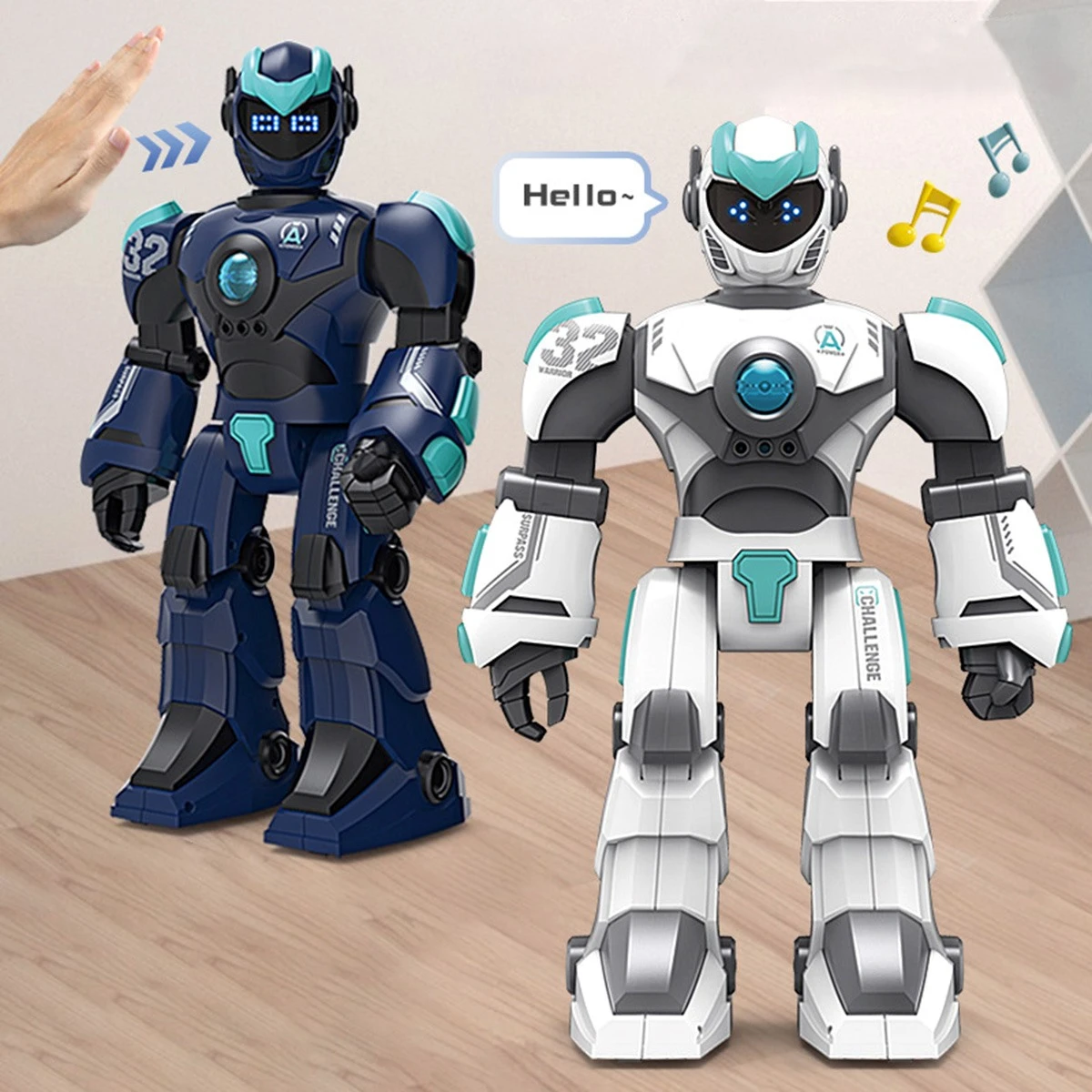
With the development of science and technology, the toy industry is undergoing a "silent revolution" - gesture sensing control technology is gradually replacing traditional buttons and joysticks, becoming the core interactive mode of the new generation of smart toys. From remote-controlled robot dogs to transforming racing cars, from stunt aircraft to interactive robots, gesture control not only makes toy operation more intuitive but also creates an immersive experience that is almost "magical" for children. The technical secrets behind this are worth exploring in depth.
The underlying logic of gesture sensing technology
The core of gesture sensing technology lies in the closed-loop system of "perception-analysis-response". Its implementation methods mainly include the following four categories:
Bioelectric signal capture technology
The epidermal electromyographic signals (sEMG) of arm muscles are collected through wearable devices (such as wristbands), combined with motion sensor data, to analyze gesture intentions. This technology can accurately identify finger micro-movements, such as clenching fists, flexing wrists, etc., and convert bioelectric signals into control commands through algorithms. Patent data shows that the layout of a multi-channel electromyographic sensor array can cover more than 90% of basic gestures.
Optical recognition system
Use infrared sensors or micro cameras to build a three-dimensional light field matrix. For example, the PAJ7620U2 sensor captures the change of hand position (accuracy of ±2cm) by the time difference between transmitting and receiving infrared light. Some high-end toys (such as aerobatic aircraft) also use structured light technology similar to Microsoft Kinect to calculate depth information through light spot displacement to achieve spatial positioning.
Inertial motion perception
Integrated six-axis sensor (accelerometer + gyroscope) to identify actions by capturing parameters such as arm swing angle (accuracy 0.1°) and acceleration (±8g range). For example, the "arm steering mapping vehicle steering" function of the eight-wheeled robot dog relies on this technology.
Environmental field sensing technology
Including electromagnetic field sensing (detecting electromagnetic disturbances caused by gestures) and ultrasonic ranging (emitting 40kHz sound waves to calculate echo time difference). This type of technology has a low cost and is often used in entry-level toys, such as some gesture remote control cars.
Key technological breakthroughs in toy gesture control
Multimodal data fusion algorithm
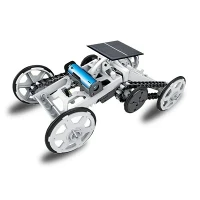
Modern toy controllers generally adopt sensor fusion strategies. Taking patented technology as an example, after digital filtering and RMS calculation, the electromyographic signal is fused with the spatial coordinate data of the motion sensor, and then gesture judgment is realized through the support vector machine (SVM) classifier, with an accuracy rate of up to 95%. Gesture-sensitive Off-road Climbing Car successfully achieves adaptive climbing on complex terrain by integrating inertial navigation and infrared ranging data.
Application of deep learning
The gesture feature library is trained through a convolutional neural network (CNN) so that the toy can recognize personalized actions. For example, the Double Side Light Stunt Car product supports user-defined gestures. After the system has learned more than 2000 training samples, the recognition accuracy rate has increased to 98%.
Low-power hardware design
The event-driven chip architecture is adopted to wake up the main processor only when gesture features are detected. The sensor module of the GX Intelligent Obstacle Avoidance Drone toy consumes only 0.8 mW of power, which extends the battery life to 60 minutes.
Typical application scenarios of gesture-controlled toys
Action mapping toys
- Stunt robot dog: wrist flexion triggers climbing instructions, and the arm tilts left and right to control the steering angle
- Transformer racing car: the waving amplitude determines the drift radius, and the hands are closed to start the body twisting function
- Aircraft: circle gesture to start spiral liftoff, palm pressed down to achieve emergency braking
Educational interactive toys
- Smart building blocks that spell letters through gestures
- Gesture programming robot (such as the number of waves represents code parameters)
Immersive gaming equipment
- VR glasses with gesture-sensing gloves to achieve virtual and real interaction
- "Gesture casting" system in AR battle games
Technical advantages and user experience upgrade
Revolution of natural interaction
Compared with traditional button control, gesture operation reduces the learning cost by 70%. Tests show that 5-year-old children can master basic gesture instructions within 10 minutes.
Improved safety
Non-contact operation reduces the risk of physical collision and there is no risk of swallowing small parts. The Folding Quadcopter is equipped with a dual redundant obstacle avoidance system, which automatically hovers when an obstacle is detected within 40cm.
Stimulation of creativity
Toys that support gesture programming (such as DIY Insect Robot Walking Bee) allow children to customize related actions such as "waving-dancing" and "clenching fists-lighting special effects," to cultivate logical thinking.
Challenges and future trends
Limitations of existing technologies
- Environmental interference: strong light/electromagnetic fields may affect the accuracy of optical/electromagnetic sensors
- False touch problem: about 5% of invalid gestures are mistakenly recognized as commands (confirmation mechanism needs to be added)
Future development direction
- Multi-technology integration: combining millimeter-wave radar (strong penetration) and electromyography (high accuracy)
- Brain-computer interface extension: predicting gesture intentions through EEG signals and shortening response delays
- Metaverse integration: gesture-controlled toys as metaverse entry devices to achieve cross-platform interaction
Conclusion
Gesture sensing control technology is reshaping the form of the toy industry. From bioelectric signal analysis to deep learning algorithms, from single action recognition to complex behavior mapping, this technology not only makes toys smarter but also opens up new possibilities in the fields of children's cognitive development, STEM education, etc. With breakthroughs in technologies such as flexible electronics and neuromorphic chips, gesture-controlled toys in the future may blur the boundaries between physics and digital, creating a truly "what you think is what you get" interactive experience.