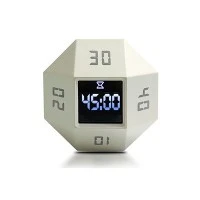
Against the backdrop of the rapid development of modern science and technology, various smart devices are emerging one after another, and some of these seemingly simple tools are also quietly upgrading. For example, the traditional hourglass or flip countdown timer (also known as the flip timer) is no longer just a mechanical device that relies on human operation, but has gradually integrated advanced sensing technology, especially gravity sensing technology. This combination not only improves the user experience, but also makes the countdown timer more intelligent and automated.
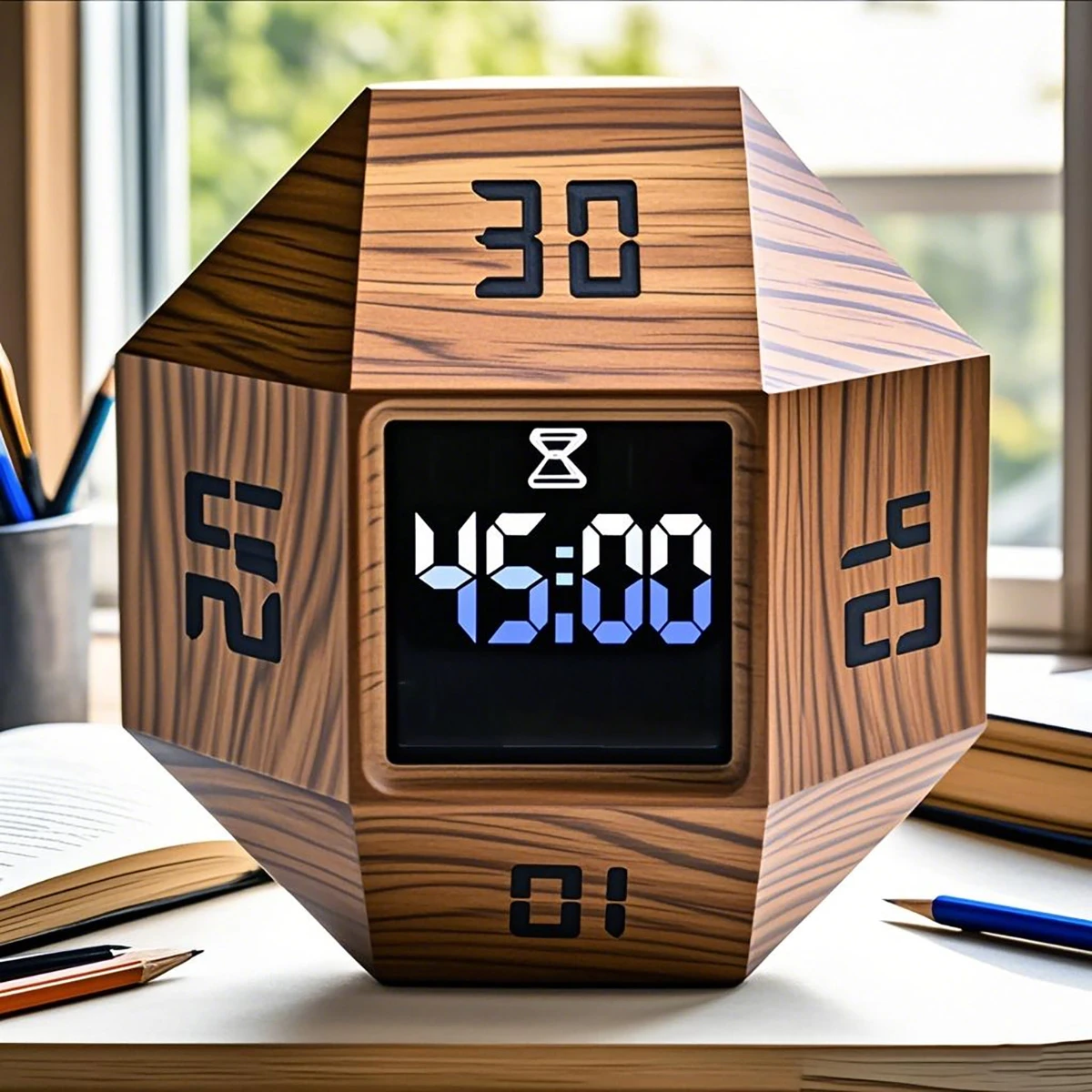
So, why can gravity sensing technology be used for flip countdown timers? What is the scientific principle behind it? What advantages and innovations does this technology bring? This article will explore this topic in depth, from the basics of physics, technical implementation to practical applications, and comprehensively analyze why gravity sensing technology is suitable for flip countdown timers.
What is a flip countdown timer?
The flip countdown timer is a common timing tool, widely used in scenes such as kitchens, meetings, and exams that require precise time control. Its basic structure is a device with a display or mechanical pointer, which starts counting down after the time is set, and emits a prompt sound or vibration to remind the user when the time returns to zero. Traditional countdown timers need to be manually flipped to restart, while modern versions can automatically recognize the flipping action through sensors, thereby realizing the automatic restart function.
Traditional countdown timers usually consist of a mechanical switch or button, and users set the time by rotating the dial or pressing the button. When the time is up, the user needs to manually flip it over to restart the timing. Although this method is simple and reliable, it lacks automation and intelligence.
With the development of electronic technology and sensors, modern countdown timers have gradually introduced sensor modules such as accelerometers and gyroscopes, allowing the device to automatically detect its spatial posture changes. When the user flips the countdown timer, the system can sense the change in direction and automatically restart the timing program. This greatly improves the convenience and fun of use.
What is gravity sensing technology?
The core of gravity sensing technology lies in the accelerometer, which is a microelectronic device that can measure the acceleration of an object. It can detect the motion state of an object in three-dimensional space, including stillness, acceleration, deceleration, and direction changes.
The technical principle of the accelerometer is to sense the external acceleration through the internal mass block and spring structure. When the device moves or tilts, the mass block will be displaced due to inertia, thereby changing the capacitance value or other electrical signals, and then calculating the current acceleration magnitude and direction.
Due to the existence of the earth's gravity, the accelerometer can detect gravity acceleration (about 9.8 m/s²) even when the device is stationary. By analyzing the direction of gravity, the device can determine its own tilt angle and orientation. For example, when the phone is placed flat on the table, the Z axis (vertical direction) feels the maximum gravity; when the phone is upright, the Y axis feels the maximum gravity. It is based on this feature that gravity sensing technology can be used to identify whether the device is "turned over".
Why is gravity sensing technology suitable for flip countdown timers?
One of the key requirements of flip countdown timers is: when the device is flipped by the user at a certain angle, can it automatically recognize and restart the countdown. And gravity sensing technology provides this capability. Through the three-axis accelerometer, the device can monitor its posture in space in real time. Assume that one side of the device is facing up in the initial state, and the Z axis will feel positive gravity (+g); when the user flips the device to a certain angle, the Z axis will feel reverse gravity (-g). By comparing the changes in the direction of gravity before and after the two times, the system can determine whether the device is turned over.
In order to prevent misjudgment (such as slight shaking or vibration), the system usually sets a direction change threshold. Only when the acceleration change of the Z axis exceeds the threshold and lasts for a certain period of time (such as more than 0.5 seconds), it is considered that an effective flipping action has occurred, thereby triggering the countdown restart.
After using gravity sensing technology, users no longer need to manually press buttons or toggle switches to restart the countdown timer. Simply flip it over and the device will respond automatically. This interaction method is more natural and intuitive. For example, the flip countdown timer developed by Modou Technology is a regular 16-hedron with 11 commonly used timing digital faces, including the tomato timer. Just flip the timer and turn the required time digital face up to start the countdown. It is very convenient and easy to use, and is very suitable for the elderly, children and adults.
Conclusion
The reason why gravity sensing technology can be successfully applied to the flip countdown timer is that it can accurately sense the posture changes of the device in space, thereby realizing the automatic flip detection and countdown restart function. This technology not only improves the user's operating experience, but also injects new vitality into traditional timing tools.
In the future, with the continuous advancement of sensor technology and the expansion of application scenarios, we have reason to believe that gravity sensing will show its unique value in more fields. Whether it is the kitchen, office or education, the smart countdown timer will become an indispensable part of our daily life.