In an era where digital technology and traditional toys collide, children's intellectual development tools are undergoing a transformation from "passive entertainment" to "active construction." Smart logic puzzles, with their "learning through play" nature, are increasingly becoming a mental training tool for preschoolers and early elementary schoolers. Unlike conventional puzzles, which rely on fixed patterns and one-way assembly, Magic Bean Technology's smart logic puzzles incorporate logic training into playful scenarios through innovative models like "area puzzles" and "obstacle puzzles." These products build a dynamic framework for children's cognitive development and unlock the power of spatial puzzles. This article will examine how smart logic puzzles, through functional design, can become "mini-laboratories" that activate children's potential.
Smart Logic Puzzles: Redefining the Educational Value of "Puzzles"
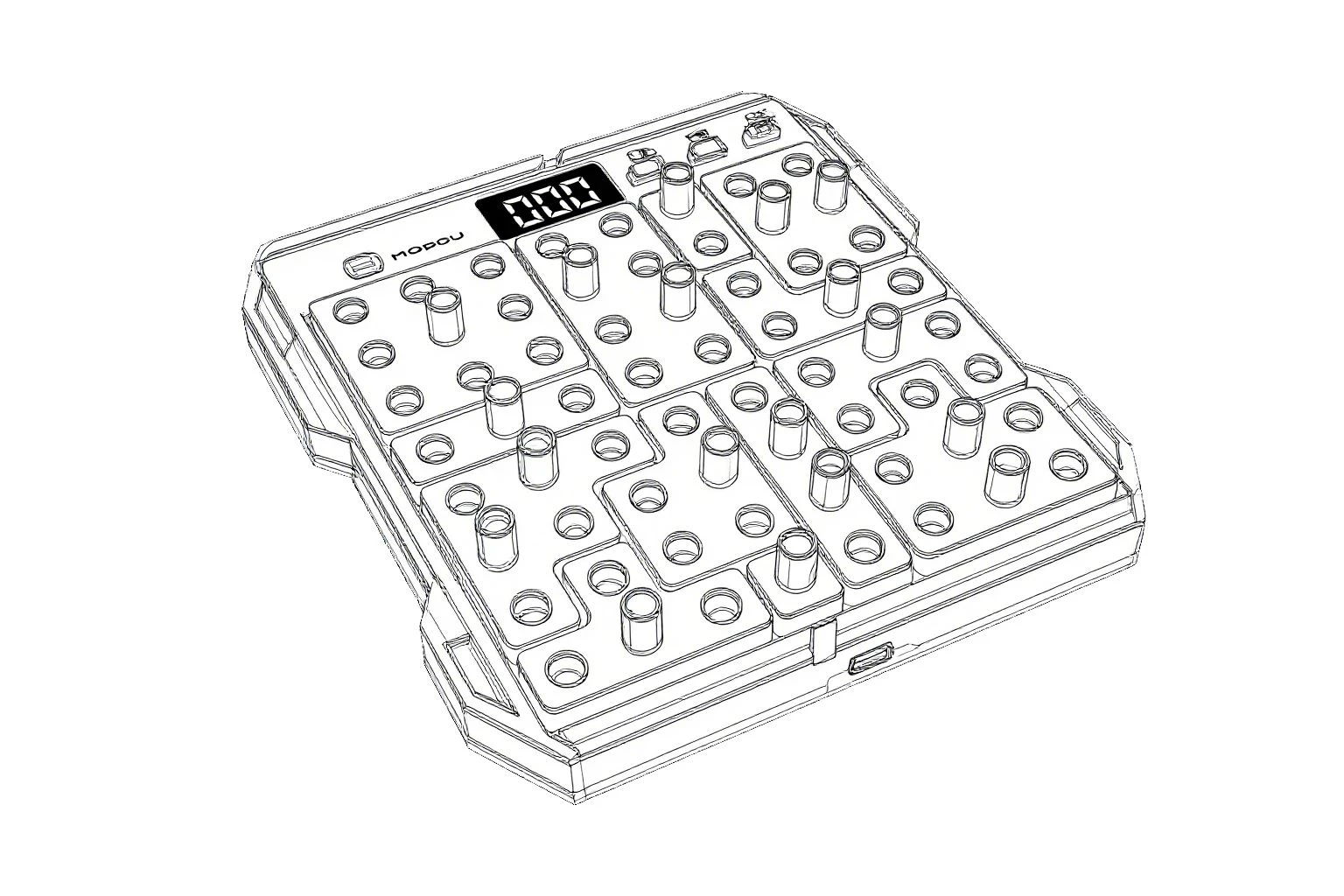
The core of traditional puzzles is "graphic reconstruction." Children piece together puzzles by observing the relationship between the whole and its parts, primarily training their observation skills and hand-eye coordination. The breakthrough of the Smart Logic Puzzle lies in its "intelligence"-it's more than just a physical puzzle; it also incorporates dynamic rules and an interactive system. Its core modules, "Area Puzzle" and "Obstacle Puzzle," offer over 800 levels, targeting two intellectual dimensions: spatial cognition and logical reasoning, respectively, creating a step-by-step training scenario. This "game + education" design allows children to actively engage in higher-order thinking, such as classification, sorting, hypothesis generation, and verification, while engaging in hands-on learning, achieving a qualitative shift from "playing with toys" to "training their brains."
Area Puzzle: Building Spatial Intelligence Through "Division and Integration"
The Area Puzzle is the foundational model for Smart Logic Puzzles, and its design stems from the key needs of children's spatial cognitive development. Children aged 3-6 are in the "concrete operational stage" (Piagetian theory), beginning to transition from intuitive perception to an abstract understanding of relationships, but still struggle with segmenting and reorganizing two-dimensional space. The Area Puzzle features over 300 different illuminated areas, each requiring a different-shaped puzzle piece to complete. Children first need to identify the overall theme of the pattern, then determine the region to which each piece belongs by observing the shapes and puzzle clues, and finally complete the puzzle. This process requires children to perform three key mental operations: pattern decomposition (breaking the whole into manageable subunits), feature matching (locating the region using local features), and spatial localization (adjusting the position of the pieces within the overall framework). Neuroscience research shows that this type of training directly stimulates the parietal cortex (the area responsible for spatial processing) and enhances children's sensitivity to "part-whole" relationships. Children who are regularly exposed to regional puzzles demonstrate stronger transferability when learning geometric figures, map reading, and even "modular thinking" in programming. As one kindergarten teacher observed, "Children who have played with regional puzzles are faster at finding the center point when learning to draw symmetrical figures and are better at planning spatial layouts when building with blocks."
Obstacle Puzzles: Forging a Logical Engine by "Breaking the Rules"
If regional puzzles are a "foundational course in spatial cognition," obstacle puzzles are "an advanced field for logical reasoning." This mode uses dynamic distractors (changeable obstacles) to force children to think outside of their usual routines and build logical chains through trial and error and adjustment. Magic Bean Technology's intelligent logic puzzles feature over 500 obstacles, requiring children to complete spatial puzzles in various obstacle modes. Children must first observe the location of the obstacles, then plan the placement of the puzzle pieces, and finally complete the puzzle. This design integrates "conditional reasoning" and "strategic planning" into the game, directly training children's conditional logic and predictive abilities. A follow-up experiment conducted by educational psychologists showed that children who used obstacle puzzles for three months increased their speed by 40% when solving classic logic problems such as "Missionaries and Cannibals Crossing the River" and "Introduction to Sudoku" and were more willing to try multi-step solutions.
From "Toy" to "Thinking Partner": The Long-Term Value of Intelligent Logic Puzzles
The significance of intelligent logic puzzles goes far beyond short-term cognitive training. Their profound impact on children's intellectual development is reflected in three dimensions of sustainability: First, they foster the development of metacognitive abilities. Switching between the two modes (from area to obstacle) requires children to constantly reflect on "what strategy the current task requires," gradually learning to monitor and adjust their own thinking processes-the core of higher-order learning abilities. Second, it fosters resilience and a growth mindset. The "periodic failure" of obstacle puzzles is designed as a learning process. Through repeated attempts, children learn that "errors are clues to optimization." This experience builds stronger mental resilience than simple success. Third, it prepares children for cross-disciplinary transfer. Spatial cognition and logical reasoning are foundational skills for learning mathematics, science, and even programming. Elementary school teachers have reported that students who have been exposed to intelligent logic puzzles demonstrate stronger transferability in first-grade "shape classification" and "finding patterns," and their class participation has significantly increased.
Conclusion: Making Thinking "Explicit" Through Play
During the golden period of children's intellectual development, we need "talking toys"-to not only bring joy but also make implicit thinking processes explicit, allowing children to "see" their own thought processes as they play. The area and obstacle modes of intelligent logic puzzles are precisely such "thinking developers." It uses the guise of a game to wrap its core logic, allowing children to quietly build lifelong thinking skills through connection, adjustment, and breakthroughs. Perhaps this is the most precious gift for children's intellectual development in the intelligent age: making growth both fun and traceable.