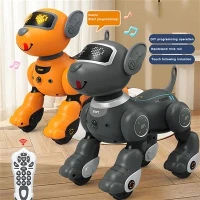
1. Origin of toy robot technology
The origin of toy robotics technology can be traced back to the early 20th century, and it has experienced the development process from mechanical toys to high-tech intelligent robots. The following are the key stages in the development of toy robot technology:
1.1. Early mechanical toys (late 19th - early 20th century)
Mechanical toys: The earliest toy robots were primarily mechanical devices, driven by a clockwork or gear system. For example, the "kite robot" toys of the late 19th century were driven by simple mechanical devices that moved through a clockwork.
Automatic toys: Some early toys, such as automatic cars and automatic animals, used complex mechanical devices. Although these toys were not powered by electricity, their design and mechanism laid the foundation for later toy robotics technology.
1.2. The Rise of electronic toys (1950s and 1960s)
Electronic toys: With the development of electronic technology, toys began to integrate electric motors and simple circuits. For example, the "mechanical clown" toys of the 1950s used electric devices to achieve movement.
Early robots: In 1956, the American toy company "Westinghouse Electric Company" introduced a toy Robot named "Robby the Robot", which was one of the early electronic toy robots, capable of performing simple actions and making sounds.
1.3. Computer Technology and Programming (1970s-1980s)
Basic programming: In the 1970s, toy robots began to introduce basic programming functions. For example, Alpha Robot, introduced in 1976, allows children to control the robot's movements through simplified programming.
Intelligent functions: In the 1980s, with the development of computer technology, toy robots began to have more complex intelligent functions and interactive capabilities. The company's products, such as "Dewey", have certain sensing and feedback functions.
1.4. Digitization and networking (1990s - early 2000s)
Digital technology: In the 1990s, advances in digital technology enabled toy robots to perform more complex controls and interactions. For example, Furby, a toy robot introduced in 1999, interacts with children through built-in chips and sensors that mimic speech and movement.
Wireless and networking: In the early 2000s, toy robots began to support wireless communication technology and were able to connect to a computer or smart device via Bluetooth or Wi-Fi, providing more interaction and control options.
1.5. Modern Intelligent Robots (early 21st century to present)
Advanced Artificial Intelligence: In recent years, toy robots have introduced advanced artificial intelligence techniques, such as natural language processing and computer vision, allowing them to have more complex conversations and interactions. Like Intelligent Robotics for Kids, Intelligent voice-controlled Police Robot, Intelligent Voice Robot, Intelligent Voice Dialogue Robot, etc., is able to identify users, conduct conversations, and perform tasks.
Education and Programming: Modern toy robots are also increasingly focused on educational functions, such as "The Smart Cop Robot, Smart Stunt Dog, Intelligent Remote Control Robot Dog, etc., which help children learn programming, problem solving, and creative thinking."
Multifunctional integration: Today's toy robots can not only move and speak, but can also program, perform tasks, connect with other devices, and even interact with augmented reality (AR) to provide diverse entertainment and educational experiences.
2. Development status of toy robot technology
Toy robot technology has made remarkable development in recent years, not only more and more diversified in function, but also has made great progress in intelligence. The following are the main directions of the development of toy robot technology:
2.1 Artificial Intelligence and Machine Learning:
Speech recognition and conversation: Many modern toy robots are equipped with speech recognition and natural language processing capabilities to carry out simple conversations with children. For example, Intelligent Voice Dialogue Robot and Intelligent voice-controlled Police Robot are equipped with such technologies.
Personalized learning: Through machine learning algorithms, toy robots can constantly adjust and improve their behavior and reactions based on the user's interaction record, providing a more personalized experience.
2.2 Sensor technology:
Environmental awareness: Toy robots are usually equipped with a variety of sensors, such as infrared, ultrasonic, camera, etc., for sensing the surrounding environment. This allows the robot to avoid obstacles, recognize colors and shapes, track moving objects, and more.
Haptic feedback: Some high-end toy robots are equipped with haptic sensors that can sense touch and pressure to provide a more lifelike interactive experience for users.
2.3 Movement and motion control:
Multi-joint design: Modern toy robots often use multi-joint design, so that they have flexible movement capabilities, such as walking, jumping, tumbling and so on.
Self-balancing technology: Using sensors such as gyroscopes and accelerometers, the toy robot can achieve self-balancing, increasing the stability and fluidity of movement.
2.4 Programming and Education functions:
Programmability: Many toy robots are designed to be programmable, and children can control the robot through a graphical programming interface or code writing, developing their programming skills and logical thinking. Smart Stunt Dog, for example, offers programming capabilities that allow the user to program the robot to perform the desired stunt.
Educational kits: Some toy robots are designed for educational purposes and come with learning kits and lessons to help kids learn STEM (science, technology, engineering and math).
2.5 Network Connection and remote control:
Wireless connectivity: Through Wi-Fi or Bluetooth connectivity, toy robots can be paired with devices such as smartphones or tablets for remote control and cloud-based interaction.
Online content update: Some toy robots can update content and software through the web, so that their functions are constantly expanded and upgraded.
2.6 Human-computer interaction Experience:
Emotional expression: Through the expression display, voice and movement, the toy robot is able to express simple emotions, making the interaction more vivid.
Augmented reality (AR) and virtual reality (VR) : Combining AR and VR technologies, toy robots can provide a more immersive gaming experience.
3.0 Problems facing the development of toy robot technology
Despite significant progress in toy robot technology, there are still some challenges and problems. Here are a few of the main issues:
3.1 Cost issues:
High research and development costs: The development of high-performance toy robots requires a large amount of research and development investment, resulting in a high price of the final product, limiting market penetration.
Manufacturing costs: The high cost of high-quality sensors, precision motors and other components also increases the overall cost of toy robots.
3.2 Battery life and Energy Efficiency:
Battery life: The complex functions and diverse sensor use of toy robots consume a lot of power, and current battery technology is not able to meet the needs of long-term use.
Charging problems: Frequent charging not only affects the user experience, but also may shorten battery life due to frequent charging and discharging cycles.
3.3 Durability and safety:
Durability of the mechanical structure: The durability and stability of the mechanical structure is an important issue as toy robots need to withstand frequent use and possible falls by children.
Safety: Toy robots need to ensure that they are harmless to children and others during use, including preventing small parts from falling off, material safety, etc.
3.4 Privacy and Data Security:
Data collection and storage: Toy robots often collect user data such as voice, image and usage habits, and how to protect the privacy and security of these data is an important issue.
Network security: The wireless connection function brings network security risks, toy robots may become the target of hackers, and network security protection needs to be strengthened.
3.5 User Experience and interactivity:
The naturalness of human-computer interaction: Although toy robots have certain artificial intelligence, their natural interaction with humans is still limited, and they need to continuously improve their dialogue understanding and emotional expression capabilities.
Variety and fun: Toy robots need to constantly update and provide diverse interactive content to keep users fresh and interested.
3.6 Ease of use of programming and education functions:
Programming interface friendliness: While programming capabilities are great for education, it is a challenge to design an easy-to-use programming interface that children can easily pick up.
The quality of educational content: Providing high-quality, systematic educational content to ensure the actual effect of toy robots in education is also a problem that needs to be solved.
3.7 Market and Consumer perception:
Marketing and education: Many parents do not know enough about high-tech toy robots, and it is necessary to strengthen marketing and consumer education to improve market acceptance.
Cultural differences: In different regions and cultural backgrounds, users' demand for and acceptance of toy robots may be different, requiring targeted adjustment of product and marketing strategies.
4. Development trend of toy robot technology
The development trend of toy robot technology reflects the progress of modern science and technology and the change of market demand. Here are some of the major trends:
4.1 Intelligence and Personalization:
More advanced artificial intelligence: With the development of artificial intelligence technology, toy robots will have stronger learning ability and adaptive ability to better understand and respond to the needs and behaviors of users.
Personalized experience: Through machine learning and big data analytics, toy robots are able to deliver highly personalized interactive experiences, tailored to the interests and habits of the user.
4.2 Combined Augmented Reality (AR) and Virtual reality (VR) :
AR and VR technology: Combine AR and VR technology with toy robots to provide an immersive and interactive experience. For example, AR glasses allow children to see virtual robots interacting with real-world environments.
Mixed Reality (MR) : Further develop mixed reality technology to blur the boundaries between virtual and reality and enhance user interaction.
4.3 Popularization of programming education:
Simplified programming interface: Design a more user-friendly programming interface to make programming education more accessible so that more children can learn programming easily.
Educational robot platform: Develop a specialized educational robot platform with systematic curriculum and learning resources to help children learn STEM knowledge.
4.4 Multi-functional and modular design:
Multifunctional integration: Future toy robots will integrate more functions, such as voice assistants, health monitoring, home security, etc., so that it is not only a toy, but also has practical functions.
Modular design: Through modular design, users can freely combine and upgrade the functions and appearance of the robot according to their needs, improving the playability and service life of the toy robot.
4.5 Sustainable and environmentally friendly materials:
Environmentally friendly materials: Use degradable or recyclable environmentally friendly materials to reduce the impact on the environment.
Energy efficient design: Optimize energy use, extend battery life, and reduce energy consumption.
4.6 Social and collaboration features:
Social interaction: Toy robots will be more social, able to interact with multiple users and even collaborate with other robots.
Collaborative learning: Through networking functions, toy robots can form a learning network to share knowledge and experience and provide richer learning resources.
4.7 Cloud and Internet of Things (IoT) integration:
Cloud intelligence: Using cloud computing technology, toy robots can access more powerful computing resources and data storage to achieve more complex intelligent functions.
Iot connectivity: Through iot technology, toy robots can be connected with other smart devices in the home to form part of the smart home.
4.8 Enhanced security and privacy protection:
Data encryption: Strengthen data encryption technology to protect user privacy and data security.
Parental controls: Provide improved parental controls to allow parents to monitor and manage their children's usage.
4.9 Interdisciplinary integration:
Interdisciplinary education: Combining toy robots with multiple disciplines such as art, music and language to provide richer educational content and cultivate children's comprehensive ability.
Interactive stories: Combine interactive stories and games to let children learn in entertainment, improve the fun and effect of learning.